Tuesday, September 18, 2007

Dear Becks, if you want to stay in England, don't bother coming back


Reprinted with permission from Ralph Speaks Sports

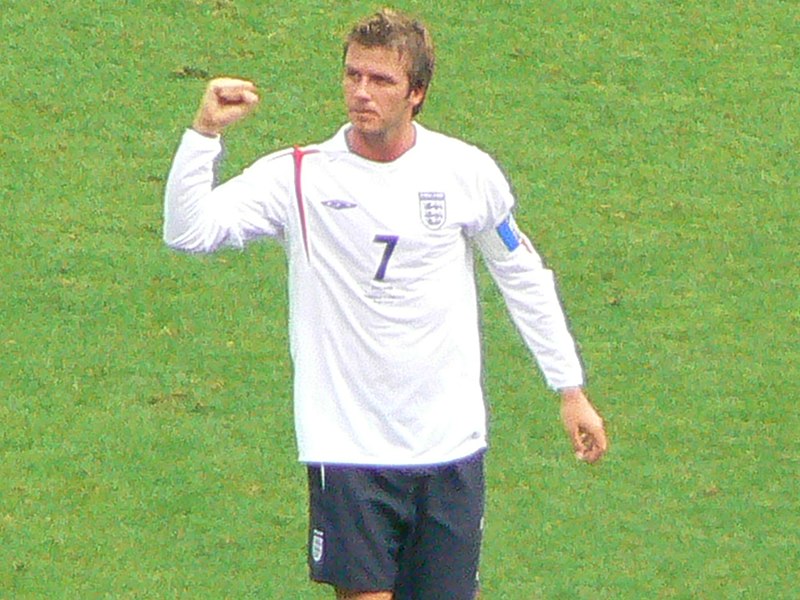
Now that he’s temporarily out of his half-hearted commitment to Major League Soccer, David Beckham can think of nothing else other than playing for England in Euro 2008. He is so focused on that competition that he wants to beg out of the first four months of the next MLS season to play in the Premier League to fully prepare himself for top flight football.

If I am MLS or the Los Angeles Galaxy, I’m beginning to feel like the new girlfriend who asked you repeatedly if you were over your old one before committing to a relationship. And right now I would feel like saying “Go back to that bitch, and don’t bother ever coming back!”

See, when Becks inked his deal with MLS, he was out of the England squad and buried deep on the Real Madrid bench. A quarter billion dollar offer from across the pond to capitalize on his fame probably seemed like the right career move at the time. But then there was his resurgence as an important part of Madrid’s championship season and his eventual recall to play for the queen, and all of a sudden going off to pasture to sell soccer in America looked like it should be years away instead of now.

So anyway, now that the bitch wants him back, he wants MLS and the Galaxy to keep the bed open and warm while he enjoys one final fling. Just to show what a true gentleman he is, Beckham said he is willing to return part of his money to MLS in exchange for a little open mindedness.

I say to MLS, “Don’t you have any pride left girlfriend?” He came to you as damaged goods, still in love with “her”, only to get hurt even worse so that thousands of your fans who bought tickets for his North American Tour are left simply watching the Galaxy, the shitiest team in the league. Get some high-priced lawyers on the job, and sue his ass for breach of contract, both in letter and spirit. And after you're through with Becks, don’t be jumping into another long-term relationship with another high priced boyfriend anytime soon.

Thursday, September 6, 2007

Beckham in America - soccer's ultimate triumph of style over substance


Reprinted with permission from Ralph Speaks Sports

Newsflash for Americans uncertain about the potential impact of David Beckham’s arrival in the states - he’s not the second coming of Pele, not even close.

Beckham is basically a one trick pony, though it is a very good trick. He is able to hit hard, precise crosses and free kicks with a tremendous amount of spin, causing the ball to “bend” as in “Bend it Like Beckham”. Though through modern global marketing he is better known in the United States than Pele was when he came here in the 1970‘s, that’s about the only thing Beckham has over him. But back then, not even the greatest player of all-time could make soccer into a major American sport, and certainly a mere soccer celebrity like Becks is doomed to similar failure.

Like a lot of people, I’ve tuned into a couple of Los Angeles Galaxy matches out of curiosity, to see how Beckham would fare against lesser competition than he faced during his days at Manchester United and Real Madrid. Since his arrival in L.A., he’s had a few shining moments, but he hasn’t even been close to being the best player on the pitch (field) let alone the top player in the league. Some part of his lackluster performances is due to an ankle injury that he picked up during English national team duty in June, but truth be told to all those casual soccer fans who thought they were getting one of the world’s greatest, Beckham is not one of the ten best players in his own country, and he’s not close to being in the top 100 worldwide.

Beckham’s new supporting cast is certainly nowhere near as talented as those he played with in Europe. In order for him to be able to “bend it”, the rest of his teammates have to do a lot of hard work to make up for some of Beckham’s deficiencies. That’s not to say he isn’t a hard worker, he just lacks some of the speed, creativity and ability to beat a defender one-on-one necessary to win at the top level. If you have players that can compliment Beckham and allow him to do his thing, then his addition to the line-up is a competitive plus. But that’s not the case with the Galaxy who have been languishing at the bottom of the MLS standings all season long.

I watched the Superliga (the North and Central American equivalent of the European Champions League) final the other night. I was mostly attracted to the match because it pitted the Galaxy, an American team, against one from Mexico, Pachuca. And yes, there was a little part of me that wanted to see what Becks could do in a big game. As most sports fans know by now, Beckham sprained his right knee on a 50-50 challenge 30 minutes into a game that the Galaxy eventually lost in penalty kicks at the game’s end. His injury was the result of having a big heart and a not so big brain (Posh Spice didn’t marry David to help broaden her mind). Beckham decided to fly over the pond to play in an exhibition match between England and Germany instead of staying home and nursing his damaged ankle. During the match with Pachuca, it was evident that he wasn’t into doing that much running, and when Landon Donovan chased a ball to the end line and back-healed it to keep it in play, he was hitting it towards Beckham. Beckham had been slow to follow the attack that he started with an incisive 30 yard pass, and he delayed for a second before going full hearted and full blast into the fateful challenge.

There is a constant struggle throughout world football between club and country for player participation. Every player wants to don the colors of his nation, but clubs pay high salaries to these athletes and resent when they come back tired or worse as damaged goods. Beckham had actually been out of the England squad until a run of good form at Madrid put him back on the team’s radar, so I understand his desire to continue to reprove himself in international competition. But when MLS gives you a quarter billion dollar deal to be its star attraction, your first responsibility is to get fit so you can deliver on that promise.

But even when fully fit, Beckham would be hard pressed to make the starting eleven of an MLS all-star team. When Pele came, he was head and shoulders above any other player in the old North American Soccer League despite being beyond his physical prime. I would far preferred to have seen MLS invest in Zinedene Zidane, master of the head butt to the chest from the French national team. Like Pele, Zidane, who retired after the 2006 World Cup, would have come to America in his mid-thirties with still enough left in the tank to school all who would play against and with him. Beckham has the occasional flash of brilliance, but the mastery of the truly great players is on display for the full ninety minutes of every match.

Like I said, Beckham is a soccer celebrity and not a soccer great, though I think he is a hell of a lot better looking than his pop star wife (are you sure he didn’t marry Scary Spice?).

Monday, May 21, 2007

American pro soccer must adopt world model


When Major League Soccer commissioner Don Garber was asked about promotion and relegation as a future part of American professional soccer, his response was, “Not in our lifetime.” At the risk of potentially condemning this man to death, it is time to cast aside his big time American sports mentality in favor of the world proven system of growing the sport up from the grassroots level.

MLS will survive longer and with more stability than its predecessor, the North American Soccer League, because of its near socialist business model of league ownership and control of individual franchises. But not even David Beckham, even followed by Zidane and Ronaldo, can increase attendance or viewership by more than an insignificant percentage. Unless MLS helps to create fanatical followings in small towns across America, it will continue to just squeak by as a marginal professional sport like hockey or arena football.

The only way to truly capture the imagination of those small market fans is to keep their eyes on the prize - promotion to the next level and potentially all the way to MLS. Franchises must be started and nurtured in areas without other professional or big time college sports. There must be investment in academies to develop local players for club and potentially country. Anyone who has traveled to a small, working class town in England has witnessed the fanatical devotion the population has to its lower division football club.

The major argument that Garber and his ilk put forth against promotion/relegation is that big investors will not want to take the risk of owning a club that may end up in a lower division. Though around the world investors understand the risky nature of the beast, they have ways of hedging their bets via insurance and player liquidation. MLS could easily create a league funded insurance program to mitigate potential losses for relegated clubs, and successful models of how to do this exist in virtually every country on the planet.

In fact, there would probably be greater investment in soccer if the current system were to change. With more opportunities at at much less cost, owners who are confident in their ability to succeed will embrace the challenge of building teams from the ground up. And with a little American capitalist know-how, they'll even turn a profit on the way.

Perhaps Garber’s lack of willingness to even consider promotion/relegation is because he hasn’t been presented with a good plan yet. Well if that’s the case, let Soccer Yanks take a crack at drafting the blueprint:

During the first two seasons, there would be promotion only. One team would come up from the top of the United Soccer Leagues each year, and another club would be added to MLS as a new franchise, bringing the total number of top division teams then to 16.

The following season would be the first to feature relegation, requiring a single 16 team table with the worst team swapping places with the USL champions. For every season thereafter, there would be two teams relegated from MLS while the USL would promote its regular season champ and the winner of a playoff between teams number two through five.

Since America is a big country, the lower divisions of the USL must be regionalized to keep travel costs down, with national playoffs to select clubs for promotion.


Think of the buzz that this type of approach would create in the American soccer community and beyond. The national media would report on it extensively. There would be much whimsical talk amongst national sports pundits of applying the system to all American sports, thus weeding out weak/joke franchises. All that’s required to make it happen is a little research and imagination.

When the modern game of soccer was developed in England in the 19th century, it was grown in the northern, working class towns. Eventually it made its way to the big stage of London and other metropolitan areas. MLS and its leadership are demonstrating arrogance and little foresight in their unwillingness to even consider a system that works almost everywhere else in the world. Despite their apparent pigheadedness, Soccer Yanks want to see promotion and relegation “within our lifetime” and sooner rather than later.

Sunday, March 25, 2007

New rules can make game more beautiful while killing some ugly old habits


At the risk of seeming a bit presumptuous or arrogant, considering that Americans are relative newcomers to the footballing world, we have some suggestions that we think can improve the game. Over the past few years, there has been discussion worldwide on how to both increase scoring potential and get rid of some of the less desirable elements of the sport.

A major overhaul of football isn’t necessary. No need to enlarge goals, do away with draws or bog the game down with endless video review. We suggest several less radical changes, which, if adopted all together, would at the minimum improve enjoyment of the game for the dedicated supporter and might even serve to broaden its appeal, particularly in the United States.

THE DAYLIGHT RULE
Nothing conspires to keep scoring down like the quick arms of timid linesmen (call them assistant referees if you like). They would far prefer to call players for being offside when they’re not rather than playing on and potentially giving a goal to a player in a slightly offside position.

Though linesmen will always be cautious in this way, an extra step can be given to the attacking player by instituting the “daylight rule”. The rule is just as its name implies; there must be clear daylight between the attacking player and the defender when the ball is played for the attacker to be judged in an offside position. This would include all body parts except the arms (too much potential to violate the spirit of the law by sticking one’s arm out) crossing a plane that runs on a 90 degree angle from the ground to soccer heaven above.

The “even is on” policy instituted several years ago, it can be argued, has had virtually no impact on making the game more offensive (in the good sense of the word). The “daylight rule” would be far more clear cut than the current law which leaves what’s considered “even” to the inconsistent interpretation of individual linesmen.

PUNISH SIMULATION LIKE VIOLENT CONDUCT
The 2006 World Cup showed the entire planet what us fanatics have known for years - diving is tarnishing both the reputation and the appeal of football. Added to this is the recent phenomenon of players faking injury or having received a blow to the face in an effort to get their fellow professional yellow or red carded.

With multiple camera angles from every match available for post-match review, virtually all simulation, where it is obvious the player hasn’t been touched or where a player claims to have been struck in a part of his body that he wasn’t, can be detected. When a player is found guilty of simulation, we suggest the following penalties:

Dive in the 18-yard box that results in a penalty kick or injury simulation that results in a red card
Three match ban for first offense, five for the second and then out for rest of season or longer.

Dive in the 18-yard box with no penalty kick awarded or a dive outside the box that results in a free kick or injury simulation that results in a yellow card
One match ban, then progression of consequences listed above for repeat offender.

The habit of simulation is ingrained in the muscle memory of players from all nations, even in the northern European countries where they fancy themselves to be above this dishonorable behavior. Only the sternest of consequences can get them to make the conscious effort necessary to change their habits. Because of the emphasis on clear daylight to punish offenders after the fact, it will still be up to referees to determine in real time whether a player has allowed himself to go to ground with minimal contact.

LIMITED VIDEO REPLAY FOR GOALS & PENALTY KICKS
The last thing that we would want is for anything, including video replay, to disrupt the flow of the game. To that end, we would only allow review by the fourth official for no longer than one minute and only in these two instances:

Ball crossing the goal line
In this day and age, it is almost retarded not to at least have some sort of goal line review. Whether the ball has entirely crossed the line isn’t an issue very often, but when it is, it’s pretty damn important, so can we spare the money for two fixed cameras per goal and some spiffy modern equipment in the tunnel for the fourth official’s review?

The referee must still make the call of goal or no goal, and the review would take place at his discretion. There would have to be indisputable proof to overturn the original call.

Penalty kick awarded
Automatic and immediate review by the fourth official. There must be clear daylight to determine that the player has dived or indisputable evidence to reverse a call of handling the ball.

If after review, a player is judged to have clearly dived in the box, he shall be shown a red card.

REAL STOPPAGE TIME
For years, referees have consistently rewarded players who fake injury in order to waste time. Tactics like this and needless last-minute substitutions are employed because refs typically add around thirty seconds for every minute of actual stoppage time. And how often do we see lazy, robot refs add on the perfunctory three minutes, whether there was five minutes of stoppage or none at all.

We propose that the fourth official should keep precise track of all stoppage time, and he shall inform the referee, not the other way around. Time added on will still be rounded down to the nearest minute, and the phrase “There shall be at least…” shall still precede the minutes to be played. The referee would then keep track of any additional stoppage time.

There will be a lot of initial grumbling about six, seven or even ten minutes of time added on, but after awhile, players will realize that they may as well just get up and take their boo-boos like men instead of rolling around like they’ve just been shot.

NO ATTACKING PLAYERS IN THE SIX-YARD BOX ON FREE KICKS
We are sure that referees are as tired of dealing with all of the crap that happens as players alternately try to screen or protect the goalkeeper as we are of watching it. This simple modification by which attackers must wait until the ball is kicked before entering the six-yard box would put an end to these shenanigans.

We firmly believe that the changes to the laws of the game that we have suggested here will do wonders towards restoring the honor and increasing the overall appeal of the beautiful game.

Please let us know what you think.